Welcome to the internal ISY pages
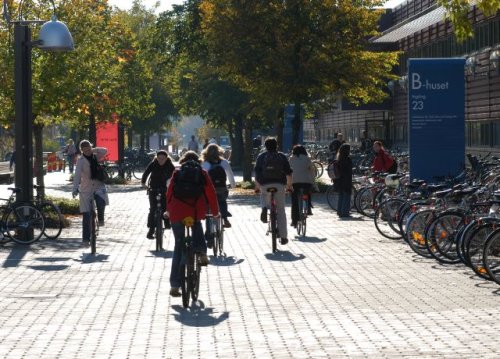
B-huset

The Department of Electrical Engineering (Institutionen för systemteknik, ISY) is central in our engineering programmes both for base knowledge and applied courses. The research is primarily focused on industrial needs and reaches from foundational questions to more application-centered issues.

Undergraduate education

The department offers more than 100 different courses within four undergraduate education areas: Images, Electronics, Automatic control, and Telecommunication. Within the university’s programs there are a number of specialisations coordinated by us.

Research

Research and research education is performed within the subject areas: Computer vision and learning systems, Electronics and computer engineering, Vehicular systems, Information coding, Communication systems och Automatic control.

Master’s thesis

Here you can read about how to find and finish a Master’s thesis with us.

Thesis defenses

  • 2026-06-25 kl 10:15 i Visionen

    Reinforcement learning for forklift pallet handling in a simulated environment

    Författare: Tobias Berglind, Oscar Sandblom
    Opponenter: Matej Brtan, Oskar Herling
    Handledare: Abbas Pasdar
    Examinator: Farnaz Adib Yaghmaie
    Nivå: Avancerad (30hp)

    Autonomous pallet handling is a central task in warehouse automation, yet
    classical control pipelines for forklifts assume structured environments and
    near-perfect pallet placement, leading to failed attempts when pallets are
    positioned with significant positional and orientational variation.
    Reinforcement learning (RL) offers an alternative that can learn robust control
    policies directly from experience. This thesis investigates RL for autonomous
    forklift pallet handling in a high-fidelity simulated warehouse environment
    built in NVIDIA Isaac Sim and Isaac Lab, focusing on robustness to variation in
    pallet yaw and forklift starting position across both ground-level and
    rack-level scenarios. The work was conducted in collaboration with Toyota
    Material Handling Europe.

    The task was formulated as a Markov decision process and solved with Proximal
    Policy Optimization using privileged state information, isolating the control
    problem from perception. Three training strategies were compared under
    equivalent conditions: a no-curriculum baseline, a success-predictor curriculum
    (SPCL), and a demonstration-based curriculum (DCL). A reward function was designed for the task, and an ablation study quantified the contribution
    of each shaping component. The best strategy was then evaluated across three deployment scenarios.
    The results show that SPCL achieved the best performance among the training strategies, with a final success rate of approximately 92%, compared to 87% for the baseline and 85% for DCL, while reaching an 80% success rate in 59 M timesteps against 78 M and 116 M. DCL matched the baseline in success rate but produced roughly three times the collision rate. The ablation study showed that each reward component served a distinct role, with progress, stop, and smoothness terms being essential for learning. Evaluated across three deployment scenarios, the selected policy reached success rates of 90.8%, 81.3%, and 61.7%, with the lowest performance on the elevated rack-level configuration.

  • 2026-09-04 kl 14:00 i ISY Systemet

    Evaluating Hybrid Key Exchange in TLS 1.3 with MbedTLS

    Författare: Hannes Linde
    Opponent: Madeleine Nilsson
    Handledare: Gustaf Åhlgren
    Examinator: Onur Günlü
    Nivå: Avancerad (30hp)